

Philippines vs India Outsourcing: Which Fits Your Team?
Philippines or India for outsourcing? A US buyer's comparison of cost, English, time zone, technical depth and retention, with a rule for choosing by role.
By Ramp RemoteUpdated
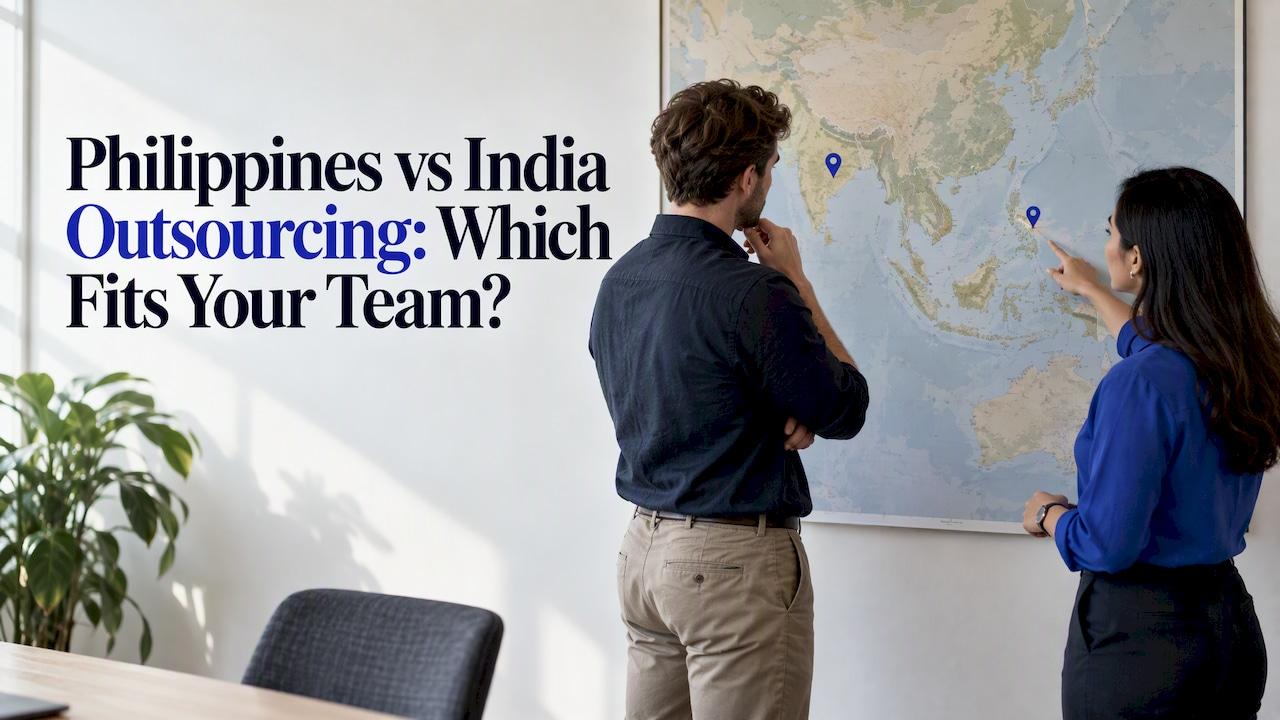
Choose the Philippines when the role talks to people: customer support, executive and virtual assistance, bookkeeping, payroll, HR coordination. Choose India when the role is engineering-heavy and you need depth or volume in technical talent. Cost is closer than most comparison pages suggest, so the deciding factors are the kind of work, how much you need to hire, and how you plan to manage the people.
This guide compares the two countries the way a US operations lead or CFO would need to: market scale, cost, communication, time zone, technical depth, retention and compliance. It ends with a simple way to decide by role.
TL;DR
- The Philippines ranked first in a 2026 global outsourcing index, ahead of India, on the strength of English, cost competitiveness and workforce capability for non-technical roles.
- India is far larger, with roughly three times the BPO workforce, and leads on engineering, data and enterprise-scale technical services.
- For most non-technical roles the fully loaded cost gap is small. Role, seniority and city matter more than the country label.
- Retention depends more on how you manage people than on where they sit. Treat offshore staff as team members, not task queues.
- Our rule of thumb: customer-facing and back-office roles go to the Philippines, deep engineering goes to India, and some companies split the two.
The two markets at a glance
India is the giant. ING estimates that the Philippines accounts for roughly 15-17% of the global business process outsourcing market, while India commands more than half of the global outsourcing industry. Both sectors are major export earners for their countries.
Headcount shows the same gap. Philstar’s report on the 2026 index puts the Philippines at about 1.9 million BPO workers and India at about 5.8 million. Scale matters if you want to hire hundreds of engineers or build a large captive center. It matters far less if you want one bookkeeper, three support agents or an executive assistant.

The same report says the Philippines ranked first globally in the Ataraxis Global Outsourcing Talent Index, with a score of 90.65, while India placed third. The reasons it gives are a balanced mix of English proficiency, cost competitiveness and workforce capability for non-technical roles. An index is one lens, and its weighting favors balance over peak technical strength. Still, it matches what buyers report: the Philippines is the safer default for communication-led work.
The history is worth knowing too. By 2011 the New York Times reported that more Filipinos than Indians were working call center jobs serving mostly American consumers, roughly 400,000 people at that time. The Philippines has been a voice-support destination for US companies for well over a decade.
Cost: closer than the headlines suggest

Many ranking pages say India is cheaper. That is true at the entry level and in tier-2 cities, but the picture shifts as roles become more senior or specialized.
Three things move the number more than the country:
- Role type. Developers, data scientists and engineers carry a premium everywhere, and India’s larger supply can soften it. Support, admin and finance roles are priced much closer together.
- City tier. Salaries in India’s major tech hubs have risen quickly. A tier-2 city can be cheaper, but it often brings a thinner talent pool and more recruiting effort.
- What the price includes. A cheap salary quote that leaves out payroll taxes, benefits, equipment, software, workspace, management time and recruiting fees is not a cheap hire. Compare fully loaded monthly cost, not base pay.
The third point is where most budgets go wrong. If you hire through an employer of record or a managed provider, the quote should cover salary, statutory costs, equipment and support in one number. Ask for that number in writing, for the same role, from each destination, before you decide.
For reference, here is what we publish for Philippines-based roles, per person per month, covering salary, compliance, equipment, support and onboarding:
| Role | Monthly price |
|---|---|
| Content Writer & Copywriter | from 1,250 USD |
| Social Media Manager, Graphic Designer, Sales Development Representative | from 1,300 USD |
| Virtual Assistant, Customer Support Specialist, HR & Recruitment Coordinator, IT Support Technician | from 1,400 USD |
| Operations Coordinator, Web Developer | from 1,500 USD |
| Bookkeeper, Payroll Officer, Executive Assistant, Data Analyst | from 1,600 USD |
| Full-Stack Developer | from 2,000 USD |
The full list and what each quote covers is on our roles page and our pricing page. Compare these with a fully loaded US hire and the saving is substantial, which is why most clients come to us in the first place.
English and communication
This is where the Philippines earns its reputation. Filipino professionals typically learn English from school age and grow up with heavy exposure to American media and business culture. In practice that shows up as an accent that US customers find easy to follow, a conversational style close to what American clients expect, and a service orientation that suits support work.
India has outstanding English speakers, and many are fluent in the technical register that engineering work demands. English is the language of Indian higher education and business, and accents and communication styles vary widely by region. For written work and technical documentation, that difference is minor. For live phone support, sales calls or an assistant who handles your executive’s inbox and calendar, the difference is easier to notice.
A 2017 academic study of voice-based offshore jobs in India and the Philippines examined the human resources and other factors that drive location choice for voice work. It is a useful reminder that the decision has always turned on people factors as much as price.
Customer support and call centers
If your question is closer to “Philippines or India for a call center,” the answer for US-facing voice work is usually the Philippines. Clients tend to prefer the accent and cultural fluency, and the country has a long track record of running US-hours support. India remains strong in technical support, where product knowledge matters more than conversational polish, and in high-volume, multilingual operations.
Time zone and working hours
Neither country is convenient for US business hours. Both involve a US evening or overnight shift. The Philippines runs the better part of a day ahead of the US, so most teams set a schedule that overlaps your morning or afternoon with their evening or early morning. India sits a couple of hours behind the Philippines, which gives it a slightly easier overlap with Europe and a slightly harder one with the US West Coast.
The practical questions are the same in both places:
- How many hours of live overlap do you need each day?
- Which tasks can run asynchronously with a handoff at the start of your day?
- Will the person work a US-aligned shift, and does your provider pay for it?
For admin, bookkeeping, payroll and support, a US-aligned shift in the Philippines is routine. For engineering, many teams are happy with a shorter overlap and a written handoff, which is where India’s technical scale can pay off.
Technical depth: where India leads
India’s advantage in engineering is real. The country has an enormous pool of developers, data scientists and IT specialists, and its software and technical services sector keeps growing. ING notes that software services exports in India rose to about 5.2% of GDP in 2026, up from 3.3% before the pandemic, which it reads as proof that demand for high-value technical work has held up despite rapid AI advances.
The Philippines has a growing technical bench, but a smaller one. It is well suited to IT support, web development, data analysis and full-stack work for small and mid-sized teams, and it is expanding into financial and computer services. If you need a 40-person engineering organization or niche specialists such as machine learning researchers, India is the more natural place to look. If you need one or two developers who will join your standups and speak your language daily, the Philippines works well. We place full-stack developers and data analysts there for exactly that reason.
What AI changes
AI is changing what gets outsourced more than whether it does. According to ING, India has been moving up into higher-value services such as finance, legal and engineering, while the Philippines is leaning into faster-growing segments like financial and computer services to offset moderation in traditional business services.
For a buyer, the useful reading is this: routine, script-driven tasks are the ones most exposed to automation. Roles that combine judgment, communication and systems fluency are safer bets, whichever country you choose. An offshore bookkeeper who uses AI tools to speed up reconciliation, or an operations assistant who builds and maintains your automations, is worth more than one who only executes a checklist.
Retention and management: the part that decides results
High annual turnover is an industry-wide issue in outsourcing, in both countries. The ILO’s executive summary on outsourcing and offshoring frames the goal as improving competitiveness through less capital commitment and faster adaptation. In practice, turnover tends to follow how people are managed: constant performance monitoring and repetitive, low-autonomy tasks push people out.
The reverse also holds. Companies that bring offshore staff into the team as real colleagues, with context on goals, a named manager, regular one-to-ones and a path to grow, keep them longer. This matters more than the choice of country.
If you are building a team rather than filling a task queue, a structured approach to talent pool management helps you keep a warm shortlist of candidates for the next hire, so a departure does not leave a hole for months.
Compliance and employment risk
Whichever country you pick, you need a lawful way to employ people there. The usual options are:
- Direct entity. You set up a local company. It gives full control but takes time, legal spend and ongoing administration.
- Contractors. Fast and cheap on paper, but misclassification risk is real and loyalty is limited.
- Employer of record or managed provider. A local employer handles contracts, payroll, statutory contributions, equipment and HR. You direct the daily work.
For most small and mid-sized US companies hiring one to twenty people, the third option is the sensible one. It avoids the cost and delay of an entity and keeps people properly employed. Ask any provider who the legal employer is, what the quote includes, what happens if you want to move the person onto your own entity later, and how you can meet candidates before committing.
How to choose by role
| If you are hiring for… | Lean toward | Why |
|---|---|---|
| Customer support, live chat, voice | Philippines | Accent, cultural fit, long US-hours track record |
| Executive or virtual assistant | Philippines | Close communication, calendar and inbox work |
| Bookkeeping, AP/AR, payroll | Philippines | Strong finance back-office talent and clear communication |
| HR and recruitment coordination | Philippines | Candidate-facing communication |
| Large engineering team, niche technical skills | India | Scale and specialist depth |
| Tier-2 city, entry-level, high-volume work | India | Often the lowest entry rates, with more recruiting effort |
| One or two developers or analysts embedded in your team | Either | Decide on interview quality and management fit |
Some companies split the work: engineering in India, everything customer- and finance-facing in the Philippines. That adds a second provider and a second time zone, so it only makes sense once you are hiring in volume.
Our perspective
We built Ramp Remote around the Philippines because most of the roles our clients need to fill are people-facing or finance-facing: bookkeepers, payroll officers, virtual and executive assistants, support specialists, operations coordinators. For that work, communication quality is the product, and it is where the Philippines is strongest.
We also think the cost debate is overplayed. Once you count payroll, compliance, equipment, software and the hours your own managers spend on recruiting, the difference between two destinations is small next to the difference between a well-managed hire and a badly managed one. Ask every provider for one monthly number that covers everything, then ask to meet the candidates yourself. That is how we work: you see the full cost up front, you interview vetted candidates, and we handle employment, payroll, equipment and ongoing support.
The mistake we see most often is treating offshore staff as a way to run a checklist cheaply. The teams that get the most from it give their offshore hires context, a manager and room to grow.
— Josh
Hiring in the Philippines with Ramp Remote
If your roles fit the Philippines, we can recruit, vet, employ and manage the person for you. You pay one monthly fee per full-time hire that covers salary, compliance, equipment, support and onboarding. See how your first offshore hire works, browse all available roles, or start with a popular one such as an offshore bookkeeper or a virtual assistant.
FAQ
Is the Philippines or India better for outsourcing?
It depends on the role. The Philippines is usually the better fit for customer-facing, administrative and finance work because of English fluency and cultural alignment with US clients. India is usually the better fit for large-scale or highly specialized technical work.
Is outsourcing to India cheaper than the Philippines?
Sometimes, mainly for entry-level roles, engineering and tier-2 cities. For most non-technical roles the fully loaded difference is small. Compare quotes that include salary, statutory costs, equipment and management support for the same role.
Which country is better for call centers?
For US-facing voice and chat support, the Philippines is the common choice, and it has been a major call center destination for US companies for years. India is strong in technical support and large, multilingual operations.
Does AI make offshore staffing a bad bet?
Not in the near term. ING’s analysis suggests AI is shifting the mix of outsourced work rather than shrinking demand. Prioritize roles that combine judgment, communication and tool fluency over purely repetitive tasks.
Sources
- Philippines tops outsourcing index, beating India (Philstar)
- Why India and the Philippines aren’t losing the AI battle yet (ING THINK)
- Philippines overtakes India as hub of call centers (The New York Times)
- Executive summary on outsourcing and offshoring (ILO)
- Determinants of offshore outsourcing locations for voice-based jobs in India and Philippines