

Accounting Offshoring to the Philippines: A US Guide
How US businesses offshore bookkeeping and accounting to the Philippines: tasks, monthly costs, controls, data security and how to get a team running.
By Ramp RemoteUpdated
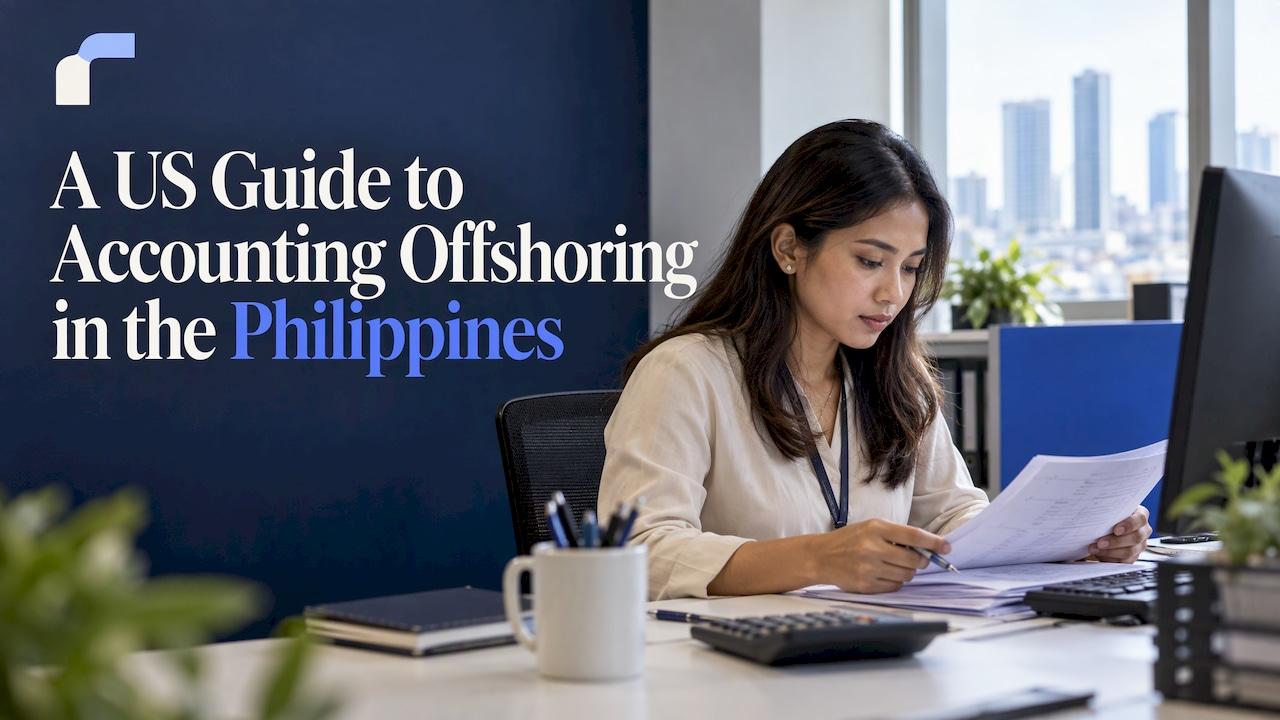
The most effective way to offshore accounting to the Philippines is to hire a dedicated, full-time accountant or bookkeeper who works inside your own systems and processes, with a partner handling employment, payroll, equipment and compliance. You keep control of the work. You stop paying US prices for tasks like reconciliations, payables and payroll prep. At Ramp Remote, a bookkeeper starts from $1,600 per month, a single monthly fee for the whole role.
This guide covers what offshore accounting teams do, what they cost, how to keep the work controlled and secure, and how to get started.
TL;DR
- Offshore accounting means a dedicated Philippine-based professional doing your bookkeeping, payables, receivables, payroll prep and reporting inside your systems.
- Ramp Remote prices accounting roles from $1,600 per month per person, covering salary, compliance, equipment, support and onboarding. We state that our clients save up to 40% on staffing costs.
- The main risks are oversight, data security and mismatched expectations. All three are managed with sign-off controls, access rules and a direct-hire model.
- A direct hire you manage gives you more control than a pooled agency team, and the employment paperwork can be handled for you.
- Most teams are working within a few weeks of choosing a candidate, once access and workflows are set.
What accounting offshoring actually means
Offshoring is hiring a person in another country to do work as part of your team. Outsourcing hands a function to a third-party firm that decides who does the work and how. The difference matters for accounting. In offshoring, the accountant uses your accounting software, follows your chart of accounts and answers to your controller or CFO.
An Accounting Today piece from April 2026 sets out the trade-off. Direct offshoring gives you staff selected for your needs, full workflow control and tight integration. The agency model can mismatch expectations: its example is a 10-person team sold as all seniors that turns out to be eight juniors and two seniors. If you want the longer comparison, we cover it in offshoring vs outsourcing.

The Philippines suits this model for a practical reason. It has a deep pool of English-speaking finance graduates and a long-established business-services sector. Philippine time is UTC+8, so teams usually work either a US-aligned shift or an overnight handoff. Agree the overlap hours before you hire.
Why US finance teams are looking offshore
The pressure is mostly about capacity. ACCA’s January 2024 guidance on outsourcing overseas cites recruiter Hays finding that over 90% of financial services employers were struggling with vacancies and recruitment difficulties. If you have tried to hire a staff accountant or an AP clerk lately, you know the feeling.
The benefits people usually name:
- Lower cost per seat. A full-time role priced in the low thousands per month instead of a full US salary plus benefits, software and office overhead.
- Capacity without a hiring drag. The recruiting, vetting and employment steps are handled for you, so the role is filled faster than a domestic search.
- Month-end relief. Routine, repeatable work moves to a dedicated person, and your senior people spend their time on analysis and decisions.
- Continuity. A full-time team member learns your business, unlike a rotating pool of agency staff.
Which accounting tasks can an offshore team handle?
Repeatable, rules-based work with clear documentation moves offshore best. Judgment calls and client-facing sign-off stay with you.
| Role | What it typically covers | Where it fits |
|---|---|---|
| Offshore bookkeeper | Transaction coding, bank and credit card reconciliations, month-end close prep | Any business running QuickBooks, Xero or similar |
| Accounts payable & receivable officer | Invoice entry, bill runs for approval, collections follow-up | Companies with high invoice volume |
| Assistant accountant | Journal entries, accruals, schedules, support for the controller | Growing finance teams |
| Payroll officer | Payroll preparation, timesheet checks, payroll reporting | Businesses with recurring payroll cycles |
| Management accountant | Management reports, budgets versus actuals, KPI packs | Owners and CFOs who want regular reporting |
| Tax accountant | Tax workpapers and preparation support | Firms with a reviewing CPA |
In every case, a qualified person in your company, or your CPA, reviews and signs off. That is how responsibility is meant to work, and we return to it below.
What offshore bookkeeping costs
The price of an offshore accountant is driven by seniority, the technical depth of the role, and how much the provider bundles into the fee. A low headline rate often leaves out equipment, payroll administration or compliance. You then pay for them separately.
Our published starting prices for accounting-related roles, each per person, per month:
| Role | Starting price |
|---|---|
| Bookkeeper | from $1,600 per month |
| Payroll Officer | from $1,600 per month |
| Data Analyst | from $1,600 per month |
| Operations Coordinator | from $1,500 per month |
| HR & Recruitment Coordinator | from $1,400 per month |
The monthly fee covers salary, compliance, equipment, support and onboarding, so the figure you see is the figure you budget. You can see what a quote includes before you commit. Browse all available roles for the full list.
A simple way to model the saving is to take the fully loaded cost of your current or planned hire: salary, payroll taxes, benefits, software licenses and workspace. Then compare it with twelve months of the monthly fee. We state that our clients save up to 40% on staffing costs. Your own number depends on the role and the market you hire in.

Controls that keep offshore accounting reliable
The sensible way to offshore accounting is with controls in place from day one. Professional bodies give consistent guidance on this, and it translates into a short list.
Keep responsibility and sign-off with you
The Journal of Accountancy notes that outsourcing creates professional liability exposure for CPA firms because the firm remains ultimately responsible for services delivered to clients. The same logic applies to a business owner: your name is on the books. Set a review step for every output that matters: a controller approves journal entries, and an owner or finance lead releases payments.
Check qualifications and sample work
The same article advises verifying a provider’s professional qualifications and technical skills, and reviewing sample outputs. When you meet candidates, give each a short, realistic exercise: a messy bank feed to reconcile, or a set of invoices to code. Ramp Remote lets you meet and select from vetted candidates yourself, so you judge the person who will actually do the work.
Work through a due diligence list
The AICPA & CIMA offshoring vendor due diligence checklist covers legal compliance, financial stability, infrastructure, data security, quality assurance, workforce expertise, client references, contractual terms, security assessments and insurance coverage. It is written for accounting firms, but any finance lead can use it as a question list for a partner.
Set up data security properly
The Journal of Accountancy recommends confirming safeguards such as an incident response plan and a SOC report, and contracting for minimum data security requirements plus indemnification for fraud or gross negligence. In practice:
- Give each offshore team member their own named logins. Never share credentials.
- Use role-based access in your accounting software: a bookkeeper can enter and reconcile but cannot approve payments or change bank details.
- Turn on multi-factor authentication everywhere.
- Keep work on company-managed devices. Ramp Remote provides the equipment for each hire.
- Remove access the day a role changes or ends.
On the Philippine side, personal data handling falls under the Data Privacy Act of 2012, and the National Privacy Commission’s implementing rules address data that is outsourced for processing, including internationally. If your records include personal data of customers or employees, include data-handling terms in the agreement. ACCA also flags that data-protection rules on transferring data across borders apply to UK firms, which is a reminder to check which rules apply to your own client data. If you handle regulated data, ask your attorney or compliance adviser.
Plan for time zones and communication
ACCA lists virtual communication across time zones among the challenges. A fixed daily check-in window, a shared task board and written handover notes solve most of it. A team member working a US-aligned shift also shortens the feedback loop considerably.
Employment: the part most guides skip
Who employs the person matters as much as who does the work. Accounting Today notes that India, the Philippines and Argentina do not have at-will employment, so terminations need more paperwork and can involve severance. That is why many US firms use a PEO or employer of record.
With Ramp Remote the staff member is employed and managed on your behalf, with HR, payroll and compliance with local labor law included. That takes the contract, payroll and labor-law work off your desk, and you manage the day-to-day. If you already have a team in the Philippines and want it handled the same way, our Ramp EOR service is built for that.
How to get started in five steps
- Map the work. List the recurring tasks you want to move: reconciliations, bill entry, payroll prep, monthly reporting. Note the software each one uses and how long it takes.
- Pick the role. Match tasks to one role. A bookkeeper and an AP/AR officer are different hires, and a first hire should be someone who can take a full, defined workload.
- Meet candidates. Interview vetted candidates and give them a short exercise based on your real work.
- Document and grant access. Write down your close checklist, coding rules and approval limits. Create named logins with limited permissions.
- Ramp up in stages. Start with one process, review the output closely for the first month or two, then add scope as accuracy holds.
Our wider guide to offshoring to the Philippines and the benefits for US teams cover the broader setup questions.
Our perspective
We built Ramp Remote around a simple idea: a finance leader should be able to hire an offshore accountant the way they hire locally, by meeting the person, seeing the full cost, and then managing them as part of the team.
Accounting is where the one-price model matters most. Salary, payroll, compliance and equipment all sit in one monthly fee, so a CFO can budget a seat without a hidden line to chase later. The person you choose is employed and looked after by us, and you direct the work.
Our advice is to start with a defined, repeatable workload such as bookkeeping or payables, put your sign-off controls around it, and grow the scope as trust builds. A dedicated team member who knows your books beats a rotating pool every time.
Josh
Hiring an offshore accountant with Ramp Remote
If you are ready to put a person on your books, start with the offshore bookkeeper role, from $1,600 per month. The fee covers recruiting and vetting, employment, payroll and compliance, equipment and ongoing support, and you select the candidate yourself. See the full role list and prices to plan a team.

FAQ
Is it legal to offshore accounting work from the US?
Yes, businesses commonly use offshore staff for bookkeeping and accounting support. The responsibility for accuracy and for protecting client data stays with you, so set review and sign-off steps and put data-handling terms in your agreement. CPA firms should also consider the professional standards that apply to them, and speak to their counsel or state board where unsure.
How much does outsourced bookkeeping in the Philippines cost?
At Ramp Remote, a full-time bookkeeper starts from $1,600 per month, and a payroll officer from $1,600 per month. The fee covers salary, compliance, equipment, support and onboarding. See the pricing page for what a quote includes.
Can an offshore accountant work in my accounting software?
Yes. Your offshore accountant works inside your existing platform with their own login and the permissions you set. Give them a documented close checklist and coding rules, and review their first months of work closely.
What is the difference between offshoring and outsourcing accounting?
Offshoring places a dedicated person on your team, and you direct their work. Outsourcing passes a function to a third-party firm that assigns its own staff. Offshoring gives you more control over who does the work and how it fits your processes.
Sources
- Outsourcing overseas, ACCA
- Offshoring vs. outsourcing your accounting and tax work, Accounting Today
- Outsourcing and professional liability, Journal of Accountancy
- Offshoring Vendor Due Diligence Checklist, AICPA & CIMA
- Implementing Rules and Regulations of the Data Privacy Act of 2012, National Privacy Commission